
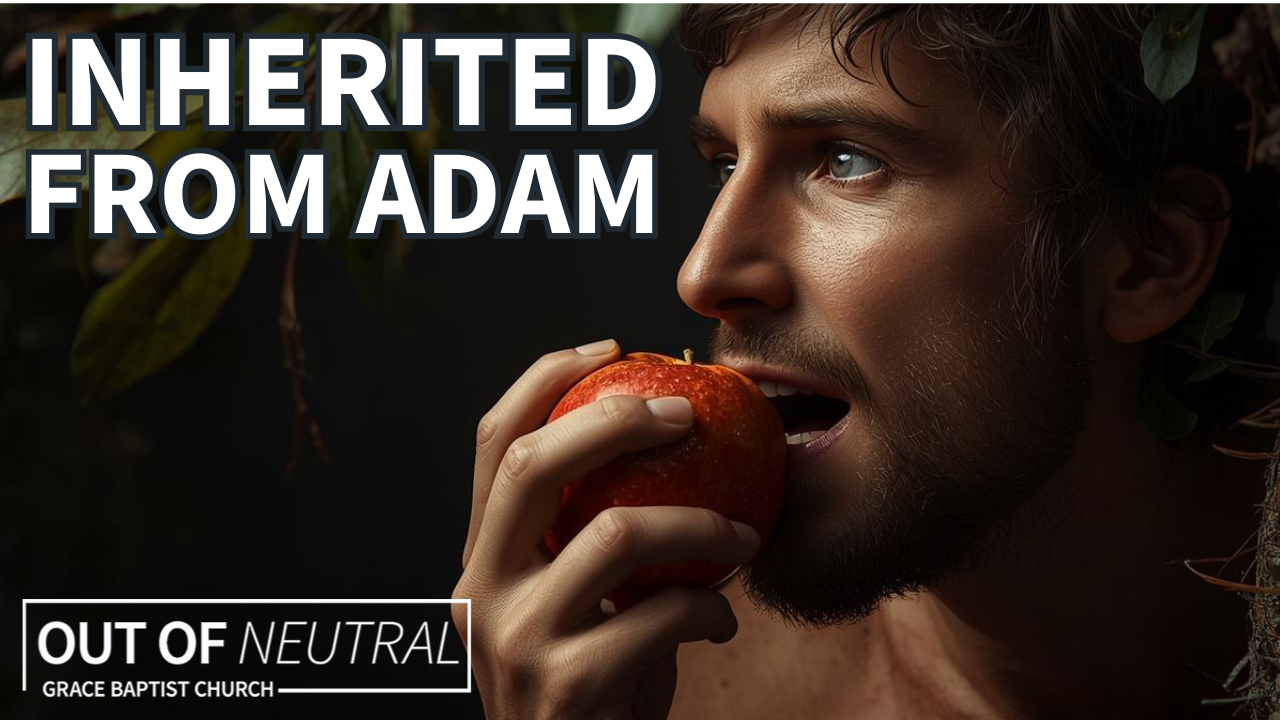
I’d like to think that I’m a fairly good person. I’d hope that my sins are the exception, not the rule. And surely my flaws are not fatal. Unfortunately, the Bible tells a different story. It describes a breakdown in the human condition that occurred as a result of Adam’s sin.
Theologians use the term “total depravity” to describe the sense in which people are born without the inclination or even the ability to love God or glorify Him as we ought. In this case, getting the diagnosis right can greatly aid in the cure.
Consider what the Bible says about our condition and compare it with how you understand humanity and the impact of Adam’s sin.
1. Adam’s sin left us all spiritually dead
We know that God warned Adam that he would “surely die” if he ate from the tree of the knowledge of good and evil (Genesis 2:17). What some people don’t realize is that Adam’s sin impacted all of us. Romans 5:12 says, for example, “sin came into the world through one man, and death through sin, and so death spread to all men because all sinned.” It’s like Adam contracted a fatal disease that spread to all of us. Romans 5:18 adds, “one trespass led to condemnation for all men.”
We can read of Adam’s sin as one individual’s story, but he was more like a quarterback throwing an interception that lost the game for the whole team. That’s why Paul can say to the church in Ephesus, “You were dead in the trespasses and sins” (Ephesians 2:1).
The result of this is that humanity has been spiritually dead since the Garden. We’re born separated from God and spiritually compromised because of Adam’s sin.
2. Sin is now humanity’s default setting
To say that we’re dead still feels abstract. But the separation from God seemed to unleash a sinful disposition in us. Paul can describe the church in Colossae, for instance, as having once been “alienated and hostile in mind, doing evil deeds” (Colossians 1:21). He wasn’t just pointing to a couple of bad apples in the bunch. He was saying that this is the human condition apart from God’s intervention. He’s even more explicit in Ephesians 2:3, when he says, “We all once lived in the passions of our flesh, carrying out the desires of the body and the mind, and were by nature children of wrath, like the rest of mankind.” Notice how he says, “by nature” and “like the rest of mankind.” Sin isn’t just something that we occasionally slip into. Now, apart from Christ, this is our nature—it’s our default setting.
That doesn’t mean that we’re as bad as we could possibly be. Nor does it imply that we’re not capable of anything good. What it does mean is that everything that we do is stained by sin. Isaiah 64:6 puts it like this: “We have all become like one who is unclean, and all our righteous deeds are like a polluted garment.” We can do good things with wrong motives, or our attitude can make a good thing less than it could have been.
The result of all this is that all people are guilty of sin. We prefer to talk about people who are better and others who are worse, but that can avoid the problem that we share in common—we’re all sinners. Ecclesiastes 7:20 says, “Surely there is not a righteous man on earth who does good and never sins.” Romans 3:23 is perhaps the most famous statement of this: “All have sinned and fall short of the glory of God.”
3. People are born morally and spiritually disabled
Many Christians will readily admit that all people sin. What we’re slower to accept is what the Scriptures say about our disability. Hear Paul describe it in Romans 7:18: “I have the desire to do what is right, but not the ability to carry it out.” It isn’t just that he doesn’t do what’s right, but he’s unable to do so. Again, he’s not saying that he can’t do anything right, but he can’t do anything without sin detracting from it in some way. No matter how straight he aims, his pencil keeps drawing crooked lines. We’re born with a moral disability.
We’re born with a spiritual disability as well. Not only do people not seek God purely and sincerely, according to Jesus, they’re unable to. In John 6:44, for instance, He says, “No one can come to me unless the Father who sent me draws him.” And in John 6:65, He adds, “No one can come to me unless it is granted him by the Father.” The word “granted” there means “given,” not “allowed.” In other words, the ability to seek God is a gift that is given to people.
The last phrase of both of those verses is the good news for the bad-news human condition that the Bible describes. While we don’t seek God on our own, He draws us to Himself. While we’re born with a moral and spiritual disability because of Adam, God heals us so that we can seek Him. He makes dead people alive. As it says in 1 Corinthians 15:22, “For as in Adam all die, so also in Christ shall all be made alive.”
The Fellowship Affirmation of Faith helpfully summarizes the Bible’s teaching on humanity.
We believe that human beings were created by God for his own glory, male and female, in his image, thus possessing immeasurable worth; that they sinned, becoming guilty before God, resulting in a state of total depravity and incurring physical and spiritual death.
If total depravity is true, then our response should be humility and hope. It frees us from pretending we’re better than we are and points us to the God who can make us alive and bring change from the inside out. It also gives us patience with others who need the same grace that we’ve received.
As Tim Keller put it: “We’re far worse than we ever imagined, and far more loved than we could ever dream.”
In awe of Him,
Paul