

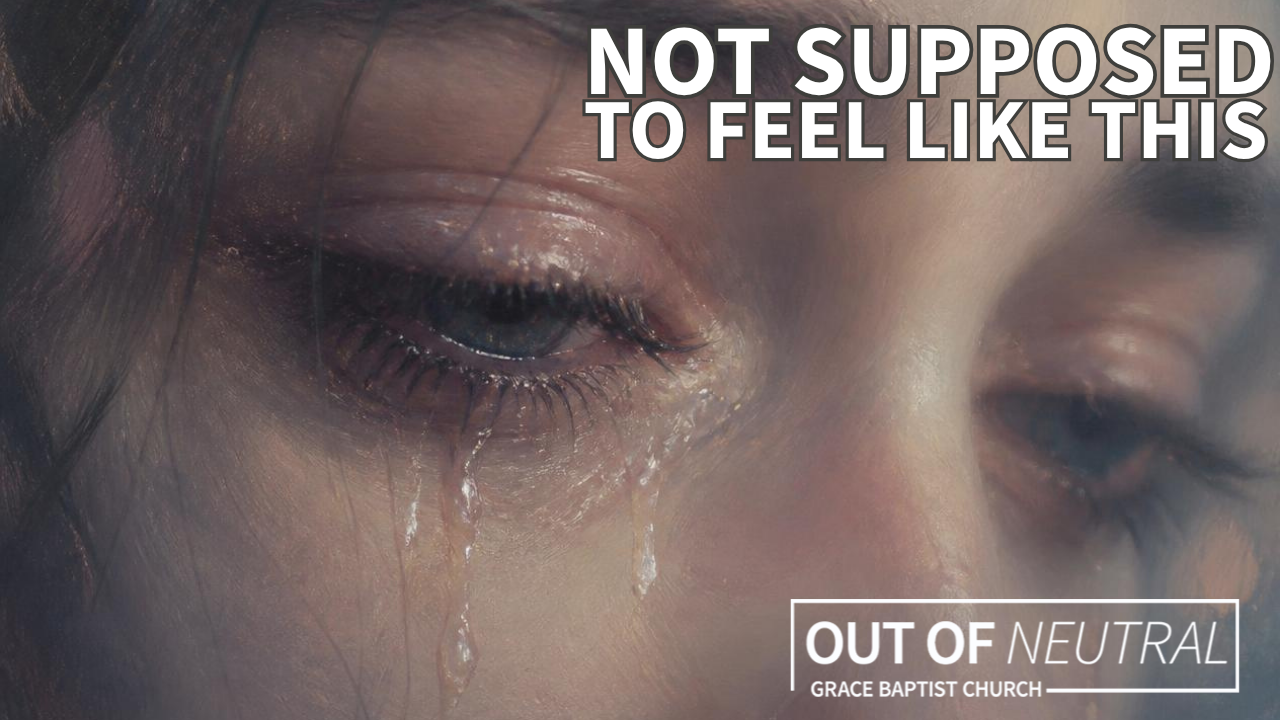
Sometimes, our struggles with grief and depression are made worse by feelings of guilt. As Christopher Williams put it, “It is bad enough that I feel low or anxious. But on top of that I feel guilty: for I ought not to feel low, as a Christian. I feel that I ought to be able to cast my cares upon him, for he cares for me. And yet somehow I can’t.”
Many Christians have heard the message of Philippians but not the message of Job, and so they’re unprepared when the pain of profound grief hits. There are three things I’d want people to remember when their grief is compounded with guilt.
1. The pain of grief can be far deeper than you imagine
We have a habit of selective reading when it comes to the Bible. Many people have heard Job’s amazing response to his tragic loss: “The LORD gave, and the LORD has taken away; blessed be the name of the LORD” (Job 1:21).
We want to be able to say, “Job suffered, but he stood strong, and so should we,” but as you read on in the book, you realize the message is closer to, “Job suffered, and it nearly destroyed him, and the same might happen to us.”
The same person who worshipped God in the face of his loss is also the one who “opened his mouth and cursed the day of his birth” (Job 3:1). In fact, as you read the rest of the chapter, you can’t help but ask, “How desperate do you have to be to sit down and write a poem somehow trying to wish your life out of existence?”
His words are more an expression of his agony than a statement of his theology. But even his rant has limits. He wishes he had never been born, but he never considers ending his life. He questions God’s plan, but he never doubts God’s existence. He curses the day of his birth, but he never curses God. As it says in Job 2:10, “In all this Job did not sin with his lips.”
The biblical word for what Job’s doing is “lament.” It’s when you complain to God and let out the pain that you’ve bottled up, but you do so in a way that’s still respectful of Him. You trust Him enough to bring Him your deepest pain without forgetting who He is.
2. The comfort of other people often falls short
If we say some things we regret when we’re feeling our worst, it probably shouldn’t surprise us that other people do as well. We desperately crave people’s comfort in our pain, but their comfort often falls short.
The Book of Job expresses this through Job’s three friends. When they heard of the tragedy he had experienced, they travelled from afar to “show him sympathy and comfort him” (Job 2:11). When they saw how broken he was, “they raised their voices and wept” (Job 2:12) and sat with him in silence for seven days and nights.
When you’re experiencing a terrible loss, it can be comforting to have someone just sit with you. The silence can be comforting – to an extent. But if you’ve lost as much as Job has and your friends show up and say nothing for an entire week, it might start to feel awkward. Do they just not know what to say? There’s no reassurance, no word of comfort, no sympathy, no prayer, nothing.
At the end of the week, Job still wants to curse the day of his birth. Sitting with his friends for a week appeared to have done little to relieve his burden. We shouldn’t be surprised if we experience the same thing. We shouldn’t blame our friends if their comfort falls short. We probably want something more than they’re able to give.
3. You’re never truly alone in the darkness
As you read the Bible, it becomes clear that while Christians might be naïve about the depth of human pain in suffering, the biblical writers weren’t.
David said, for instance, “Reproaches have broken my heart, so that I am in despair. I looked for pity, but there was none, and for comforters, but I found none” (Psalm 69:20).
Jeremiah’s words sound similar to Job’s. “Cursed be the day on which I was born! The day when my mother bore me, let it not be blessed!” (Jeremiah 20:14).
On the night when he would be betrayed, even Jesus said, “My soul is very sorrowful, even to death” (Mark 14:34).
If Jesus could feel that, let’s never beat ourselves with thoughts of “I’m a good Christian. I’m not supposed to feel like this.” And let’s not assume it’s a sign that God has abandoned us or that it’ll always be like this. Job came out the other side. So did David. Jesus’ relief came on the other side of the cross. They teach us to wait on the Lord.
And the saints of old remind us not to doubt in the darkness what God has revealed in the light. As C.S. Lewis observed of his own grief, “You can't see anything properly while your eyes are blurred with tears.”
In awe of Him,
Paul