

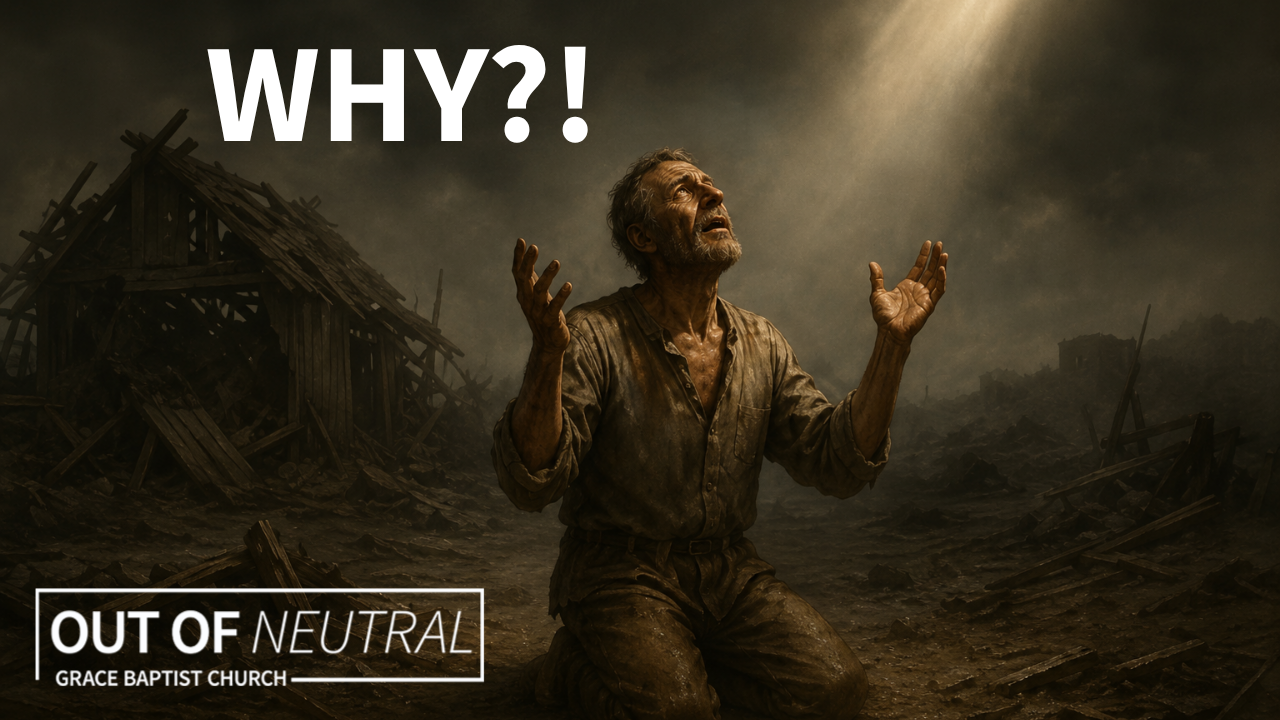
Painful circumstances often make us ask questions. Why is this happening to me? Is life even fair? Does God see what I’m going through? Darkness prompts those questions, and they can tempt us to doubt what God has already revealed in His Word. The Book of Job poses a different question. It offers a question that’s being asked of us when we face trials, and it’s an important one for us to answer. Consider the context for the question, the question itself, and how Job answered it.
Until it’s you, you’ll probably underestimate human suffering
Anybody who’s heard of Job knows that he faced unimaginable tragedy. Even still, reading the details (Job 1:13-19) shocks the senses. First, Sabean invaders kill his servants and rob his massive herds of oxen and donkeys. Then, fire strikes his sheep pens and kills his sheep and the servants who were shepherding them. Next, Chaldean thieves take off with his camels and kill the servants who were guarding them. Finally, a hurricane strikes the home of his firstborn son, killing all his children.
As we reflect on the gruesome tragedy, we realize how superficial a view of human pain most of us have. Often, we’d rather not admit that suffering like that is possible, so we tend to look away or downplay how bad it is. Job’s suffering forces us to prepare for our own and feel more compassion toward the suffering of others.
When tragedy strikes, we’re asked what motivates our love for God
We know that Satan is behind the attacks on Job’s life. What’s less understood is the question that precedes those attacks. God presents Job as a model of faith and virtue: “there is none like him on the earth, a blameless and upright man, who fears God and turns away from evil” (Job 1:8).
Satan doesn’t question Job’s moral track record, but he does challenge his motivation. In Job 1:9, he asks, “Does Job fear God for no reason?” He figures that Job’s obedience is simply a transaction to get God’s blessing. He assumes that he has a selfish, “in-it-for-what-he-can-take-from-it” relationship with God.
Jesus taught that the greatest commandment is to “love the Lord your God with all your heart and with all your soul and with all your mind and with all your strength” (Mark 12:30). And many of us want to say, “Of course I love God like that.” But it’s only as we face loss, pain, and suffering that our love is tested. We’re asked what motivates our love: whether we love God for His gifts or because He is worthy. Are we just in it for the good times, or is our love for God “for better or for worse, for richer or poorer, in sickness and in health, till death do us part”?
Grateful worship is our strength in suffering
Job’s response to his suffering is as profound as the suffering that he faced. He tears his robe, shaves his head, falls down in worship, saying “Naked I came from my mother’s womb, and naked shall I return. The LORD gave, and the LORD has taken away; blessed be the name of the LORD” (Job 1:20-21).
The tearing of his robe and shaving of his head were cultural expressions of grief that tell us that Job wasn’t just trying to keep a stiff upper lip. He feels his pain deeply. Even still, he chooses to worship.
Job shows us that a trial is when we’re least likely to want to worship but also when we most need to. Because the storm pressures us to interpret God through our changing circumstances, and worship teaches us to see our circumstances in light of our unchanging God. In worship, we affirm all that we know about God and all that He’s revealed about Himself.
Without worship, Job would have been tempted to say, “I earned all this, but God took it away.” Through worship, Job was able to say, “I’ve lost everything, but God is the one who gave it to me in the first place. And my tragedy doesn’t erase God’s generosity or His faithfulness.”
Trials reveal what prosperity can hide. They expose whether we’ve loved God for His gifts or because He is worthy. And as we worship Him in suffering, we discover that He Himself is better than anything suffering can take away.
In awe of Him,
Paul