

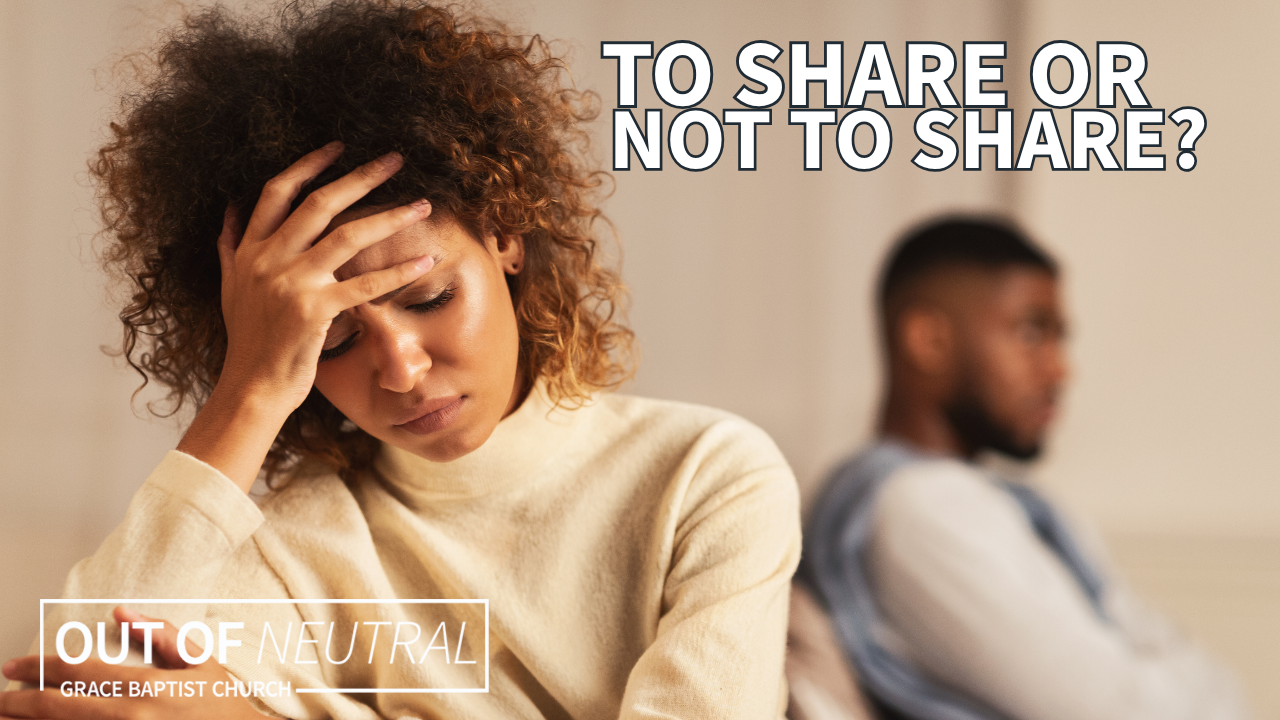
Many people feel good about what they don’t say to their partner. They’re glad they don’t blow up. They’re relieved they don’t say things they’d later regret. They’re happy that there aren’t heated arguments. And those are things to celebrate. But a couple that doesn’t find gracious ways to talk about hard things or the time to open up about their true feelings will gradually find themselves drifting apart.
Are you shutting down when conflict occurs?
In marital and premarital counselling, there are a number of ways that a lack of communication can show itself. One of the most obvious is related to conflict. When there is a problem, it’s common for one partner to shut down or walk away. This is almost always interpreted as an unwillingness to deal with the issue or a lack of concern for the relationship: “If he loved me, he’d stay to resolve this issue.” Usually the person shuts down, though, because they don’t want to say the wrong thing, or they need time to process their own thoughts.
Sometimes, the person has learned by experience that negative feelings aren’t received well, so they’re afraid to express them, and they say nothing as a result. If your partner is shutting down, ask yourself whether your reactions are what keep them from expressing their thoughts. If not, ask them whether they just need time to collect their thoughts. Not everyone moves at the same pace, but when conflicts aren’t resolved, everyone loses.
Are you pushing your partner away by not sharing how you really feel?
It’s not just in conflict that a lack of communication can affect a marriage. Sometimes, people express that they don’t want to burden their spouse with their troubles. The problem is that the spouse can usually see that there’s a problem, and the unwillingness to share it is usually perceived negatively: “I feel like they won’t let me in. Why don’t they trust me?” If marriage is a relationship where two become one, couples need to work at sharing their feelings, needs, and problems. When they don’t, distance begins to creep in.
Are you learning from the relationship that the Lord invites us to have with Him?
The ideal of relational openness in marriage is modelled for us in the Lord’s relationship with us. Many people experience a great freedom in first reading the Psalms because they realize that God encourages us to express all that’s on our heart, even when it’s messy. Psalm 62:8, for instance, says, “Trust in him at all times, O people; pour out your heart before him; God is a refuge for us.” In the New Testament, 1 Peter 5:7 urges us to cast “all your anxieties on him, because he cares for you.” We can’t bear one another’s burdens in the way that the Lord can, but learning to express what’s inside to your spouse draws you closer and deepens your support. And Proverbs 20:5 encourages wisdom in helping others to share. It says, “The purpose in a man’s heart is like deep water, but a man of understanding will draw it out.”
Healthy couples make time to tell each other what they’re feeling and don’t assume that their partner can read their minds. But openness doesn’t necessarily mean saying everything the moment you feel it, nor does it mean speaking without wisdom or grace. It means caring enough about the relationship to find a way to let your spouse know what’s going on in your heart. Your spouse may not always be able to fix what you’re facing, but they can listen, pray, comfort, and walk with you through it. Sometimes, what brings a couple closer isn’t solving the problem; it’s allowing each other into the struggle.
In awe of Him,
Paul